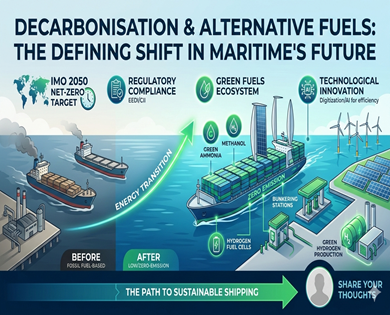
The global maritime industry is undergoing one of its most significant transformations in decades. Decarbonisation is no longer a distant ambition, it is an operational reality. With tightening emission regulations, increasing investor scrutiny, and growing environmental awareness, the pressure to reduce greenhouse gas emissions is reshaping fleet strategies worldwide.
The Rise of Alternative Fuels:
Shipowners and operators are actively investing in vessels capable of running on cleaner fuels such as:
• LNG (Liquefied Natural Gas)
• Methanol
• Biofuels
• Hydrogen-ready systems
These alternatives are helping reduce carbon intensity while supporting compliance with evolving global and regional environmental standards. Dual-fuel engines, fuel-flexible designs, and retrofit solutions are becoming central to newbuild and fleet modernization projects.
While international carbon pricing frameworks continue to evolve, the industry is not waiting. Many organizations are proactively implementing decarbonisation strategies, integrating energy efficiency technologies, optimizing vessel performance, and investing in long-term fuel transition plans.
𝐖𝐡𝐲 𝐃𝐞𝐜𝐚𝐫𝐛𝐨𝐧𝐢𝐬𝐚𝐭𝐢𝐨𝐧 𝐌𝐚𝐭𝐭𝐞𝐫𝐬 𝐍𝐨𝐰?
Decarbonisation is driven by three powerful forces:
1️⃣ Regulatory Pressure
Stricter emission norms and efficiency indices are pushing fleets toward measurable reductions in carbon intensity.
2️⃣ Investor & Stakeholder Expectations
Financial institutions and charterers increasingly evaluate environmental performance as part of their risk and ESG criteria.
3️⃣ Fuel Economics & Operational Efficiency
Cleaner technologies often align with long-term cost optimization through improved fuel efficiency and reduced penalties.
The result? Sustainability is no longer just about compliance — it has become a strategic advantage.
Navigating the Transition with Confidence.
Transitioning to alternative fuels and lower-carbon operations is complex. It requires:
• Technical feasibility studies
• Risk assessments
• Retrofit and conversion engineering
• Lifecycle performance optimization
• Regulatory compliance support
At FloatSys, we support shipowners, operators, and maritime stakeholders with comprehensive Marine & Offshore Engineering solutions, advanced technical analysis (including FEA and performance studies), third-party inspections and audits, risk and management consulting, and specialized training through FloatSys Academy.
As the industry accelerates toward a cleaner future, FloatSys remains committed to enabling safer, smarter, and more sustainable maritime operations.
Let’s collaborate to build the future of low-carbon shipping.
#MaritimeIndustry #Decarbonisation #AlternativeFuels #Sustainability #MarineEngineering #FloatSys #elearning


.jpg)