.jpg)
The offshore sector in 2026 is being shaped by more than market demand and project schedules. The real transformation is happening at the engineering level—where data, advanced analysis, automation, and sustainability are redefining how offshore assets are designed, built, and operated.
From concept design to lifecycle performance, engineering teams are now expected to deliver higher reliability, lower emissions, faster execution, and stronger commercial outcomes.
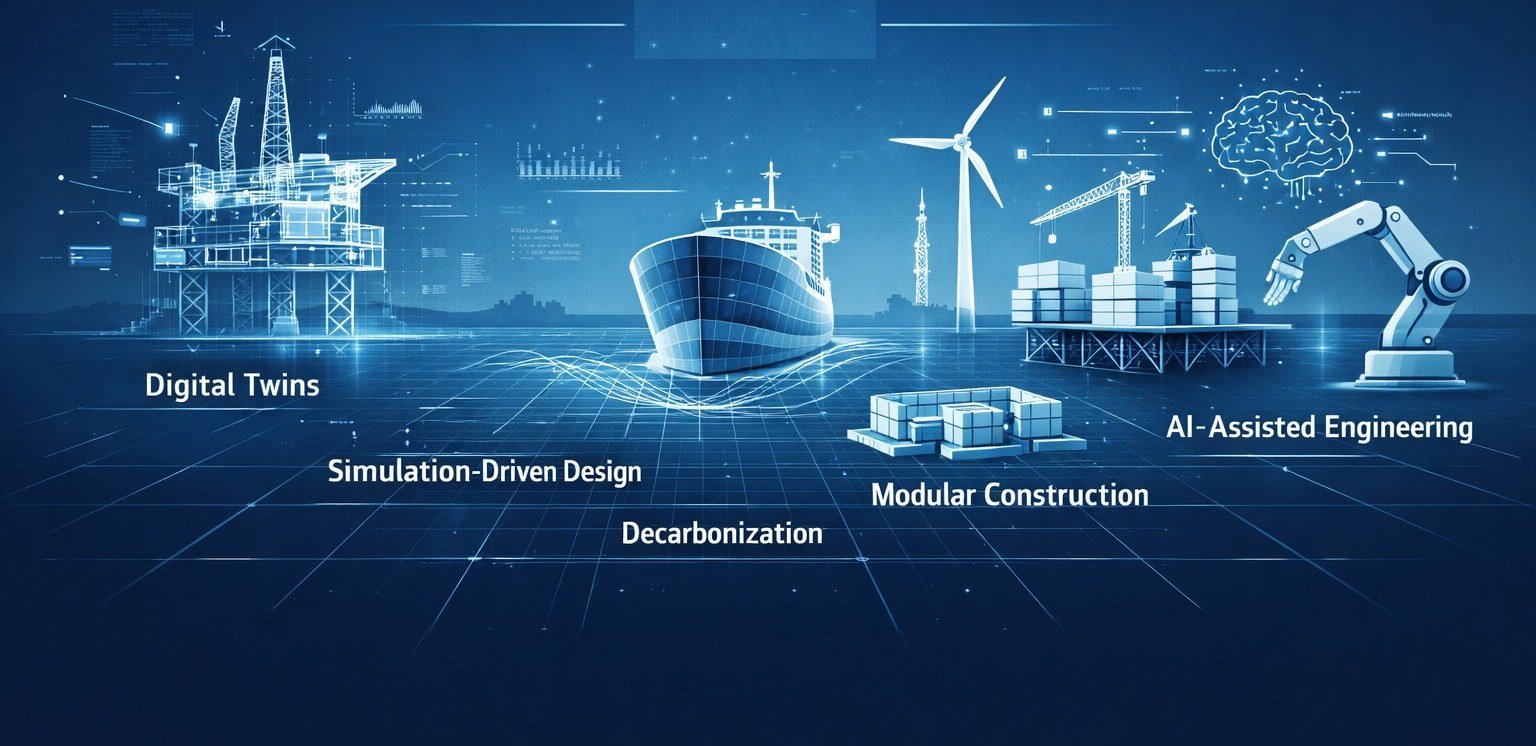
Here are the Top 5 Technical Trends Shaping Offshore Engineering in 2026.
1️⃣ Digital Twins: Real-Time Asset Intelligence for Offshore Operations
A Digital Twin is no longer just a 3D model. It is a dynamic engineering environment that combines design data, sensor inputs, operational history, and predictive analytics into a live virtual replica of an offshore asset.
For offshore platforms, FPSOs, subsea systems, and marine assets, digital twins enable continuous technical assessment throughout the asset lifecycle.
Technical Applications:
Structural health monitoring using strain, vibration, and fatigue data, Real-time equipment performance tracking, Predictive maintenance of rotating machinery, Scenario modelling for process optimization, Remaining useful life (RUL) estimation
Engineering Value:
Digital twins allow engineers to move from periodic inspection strategies to condition-based and performance-driven decision making.Is your asset data integrated into engineering decisions—or stored in isolated systems?
2️⃣ Simulation-Driven Design: Engineering Validation Before Fabrication
Offshore structures operate under highly complex loading conditions including wave loads, wind loads, current forces, thermal effects, and cyclic fatigue. Traditional design margins alone are no longer enough. Simulation-driven design uses advanced numerical tools to validate engineering performance before fabrication begins.
Core Analysis Areas:
Finite Element Analysis (FEA) for local and global structural response, Computational Fluid Dynamics (CFD) for hydrodynamics and flow assurance, Fatigue life assessment under cyclic loading, Mooring and station-keeping analysis, Motion response studies (RAO / seakeeping), Nonlinear load case evaluation
Engineering Value:
Reduced overdesign and structural weight, Early detection of stress concentrations, Improved code compliance confidence, Lower rework costs during construction.
The most cost-effective engineering change is the one made during analysis—not after installation.
3️⃣ Decarbonization: Engineering for Low-Emission Offshore Assets
Decarbonization in offshore engineering is now directly influencing design specifications, machinery selection, and operational philosophy. Rather than viewing emissions as a reporting metric, engineering teams are integrating carbon reduction into core system design.
Technical Focus Areas:
Hybrid power systems with battery integration, Waste heat recovery systems, Energy-efficient HVAC and auxiliary systems, Low-resistance hull and topside design optimization, Alternative fuel readiness (hydrogen, ammonia, methanol), Carbon intensity monitoring systems
Engineering Challenges:
Space and weight constraints, Safety requirements for new fuels, CAPEX vs lifecycle savings analysis, Retrofit feasibility for existing assets
Engineering Value:
The future advantage will belong to projects that achieve compliance without compromising operability, safety, or economics.
4️⃣ Modular Construction: Designing for Parallel Execution
Modularization is changing offshore project execution by shifting construction effort from offshore/on-site environments to controlled fabrication yards. Instead of treating modular construction as only a fabrication strategy, leading companies are integrating it at the engineering stage.
Technical Requirements:
Interface management across modules, Lifting and transportation analysis, Structural reinforcement for transport loads, Tolerance management during assembly, Piping, cable, and HVAC routing integration, Installation sequencing studies
Engineering Value:
Reduced offshore hook-up time ,Improved quality assurance, Better schedule predictability, Lower HSE exposure during installation
Modular success is determined in the design office long before modules reach the yard.
5️⃣ AI-Assisted Engineering: Accelerating Technical Decisions
Artificial Intelligence is increasingly being used to support—not replace—engineering judgment. In offshore projects, where large volumes of data are generated across design, operations, and maintenance, AI helps convert data into actionable insights.
Emerging Engineering Use Cases:
Predictive maintenance from equipment sensor data, Design optimization across multiple variables, Automatic anomaly detection in operational systems, Intelligent document and drawing review, Resource and schedule forecasting, Risk pattern recognition from historical failures
Engineering Value:
Faster engineering workflows, Better decision support, Improved asset uptime, Reduced manual analysis effort
AI is most effective when combined with domain expertise, validated data, and engineering governance.
The future of offshore engineering will be defined by organizations that combine classical engineering fundamentals with digital capability, advanced analysis, and sustainable design thinking.
These trends are not independent—they are interconnected. A digital twin relies on quality simulation models. Decarbonization depends on smarter system design. Modular construction benefits from integrated digital workflows. AI becomes valuable when engineering data is structured and reliable.
At FloatSys, we recognize this shift and remain committed to supporting the industry through detailed engineering, advanced analysis, simulation-driven solutions, and practical innovation for next-generation offshore projects.
Which of these technologies do you believe will create the highest engineering value over the next five years?
#OffshoreEngineering #MarineEngineering #FEA #CFD #DigitalTwin #AI #Decarbonization #EngineeringAnalysis #OffshoreProjects #Shipbuilding #FloatSys


.jpg)