In marine engineering, ballast management is often associated with vessel stability. But from a naval architecture perspective, ballast operations are equally critical for maintaining structural integrity throughout loading, unloading, transit, and offshore operations. Improper ballast distribution can generate excessive hull girder stresses, increase fatigue loading, and compromise long-term vessel reliability.
Modern ships are essentially massive floating beam structures continuously subjected to dynamic environmental and operational loads. Effective ballast management ensures these loads remain within allowable structural limits.
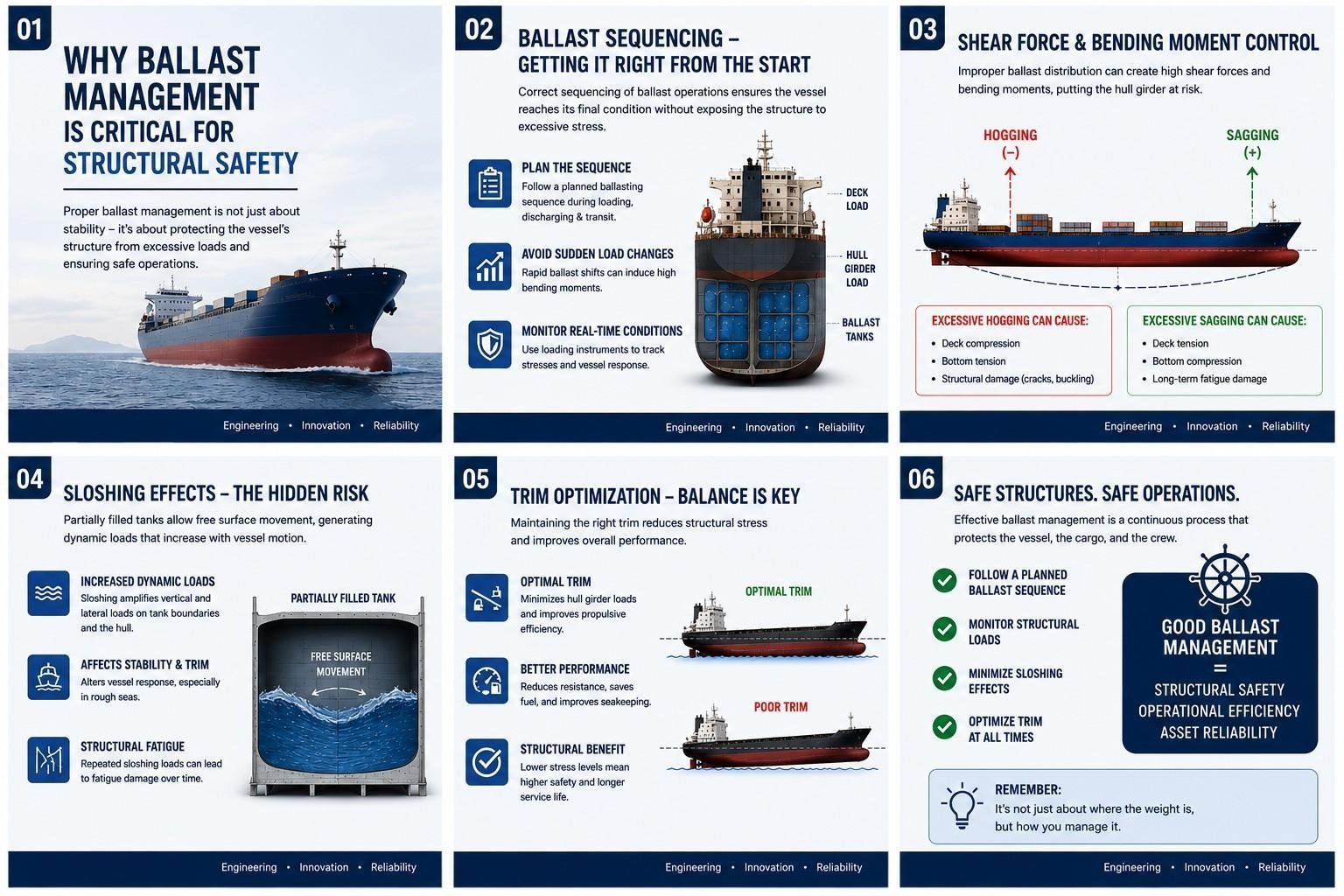
1. Ballast Sequencing — More Than Filling Tanks
Ballast sequencing is the controlled process of filling or emptying ballast tanks in a predefined order during cargo operations and voyage transitions. Incorrect sequencing can create:
Uneven longitudinal loading, Rapid stress redistribution, Excessive local and global bending moments, Temporary structural overstressing For large vessels such as bulk carriers, tankers, and container ships, even short-duration imbalance conditions can significantly increase hull girder loads.
A well-planned ballast sequence helps:
✔ Maintain structural continuity
✔ Avoid abrupt load transitions
✔ Reduce transient stress peaks
✔ Ensure safe cargo operations
This is why loading manuals and loading computer systems are critical tools in modern ship operations.
2. Shear Force & Bending Moment Control
Every vessel experiences longitudinal shear forces and bending moments due to the combined effect of: Cargo distribution, Ballast distribution, Buoyancy variation, Wave action Improper ballast management can lead to: Excessive hogging ,Excessive sagging, Deck compression or tension, Bottom shell overstressing, Structural fatigue accumulation
Hogging
Occurs when wave buoyancy or ballast conditions cause the midship region to bend upward. Potential effects:Deck compression, Bottom tension, Crack initiation in deck structures
Sagging
Occurs when the midship region bends downward. Potential effects:Deck tension, Bottom compression, Buckling risks, Long-term fatigue damage Maintaining allowable shear force and bending moment envelopes is therefore essential for structural safety and class compliance.
3. Sloshing Effects — The Hidden Dynamic Load
Partially filled ballast tanks introduce free surface effects and sloshing phenomena. When vessels experience roll, pitch, or heave motions: Fluid momentum shifts dynamically, Impact pressures develop on tank boundaries, Dynamic loads amplify structural stresses. Sloshing can contribute to:
Internal structural fatigue, Tank boundary deformation, Increased vibration response, Stability reduction due to free surface moments
This becomes especially critical in: LNG carriers, FPSOs, Offshore support vessels, Heavy weather operations. Optimized ballast planning minimizes partially filled tank conditions wherever operationally possible.
4. Trim Optimization & Operational Efficiency
Trim directly affects: Resistance characteristics, Propulsion efficiency, Fuel consumption, Hull girder load distribution. Poor trim conditions can: Increase resistance, Create uneven structural loading, Increase slamming probability, Reduce operational efficiency
Optimal trim helps:
✔ Reduce hull stresses
✔ Improve seakeeping
✔ Enhance fuel efficiency
✔ Improve vessel response in waves
Today, trim optimization is increasingly integrated with digital performance monitoring systems and voyage optimization platforms.
5. Ballast Management as a Structural Engineering Discipline
Ballast operations are not simply operational procedures — they are a structural engineering function.. Safe ballast management requires:
Load case evaluation, Longitudinal strength assessment, Stability verification, Dynamic response consideration, Compliance with class and operational limits. In modern marine engineering, proper ballast management directly contributes to: Structural reliability, Fatigue life extension, Operational efficiency, Asset integrity, Crew and cargo safety.
As vessel sizes continue to increase and offshore operations become more demanding, intelligent ballast management will remain one of the most important aspects of safe marine operations.


.jpg)